

A finance employee at engineering firm Arup once sat through an entire video call with AI-generated deepfakes of his company’s CFO and colleagues, watched their faces move, heard their voices, and authorized a $25.6 million transfer.

None of it was real and the fraud only unraveled after the money was already gone.
Cases like Arup’s prove that AI regulation isn’t a distant policy debate. It touches daily financial security. Given how heavily modern crypto fraud relies on hyper-realistic impersonation, this is one of the most consequential tech policy developments for crypto users today.
What the EU AI Act Actually Requires Starting Now
The EU AI Act, formally Regulation (EU) 2024/1689, entered into force back in August 2024, rolling out obligations in staged phases. The specific rules making headlines now stem from Article 50 (Transparency Obligations), which became enforceable on August 2, 2026. You can review the full official text directly on EUR-Lex.
In plain terms, any AI system reaching EU users must follow three strict transparency rules:
1. Mandatory Identity Disclosure
Chatbots and virtual support agents must clearly inform users that they are speaking with an AI, not a human. This disclosure must be immediate and perceivable during the interaction itself—never hidden in terms-and-conditions fine print.
2. Machine-Readable Watermarking
AI-generated or manipulated images, audio, video, and text must carry machine-readable digital marks identifying them as synthetic content.
3. Strict Deepfake Labeling
Content depicting real, identifiable people must explicitly state that it is artificially generated. This obligation applies even if there was no intent to deceive or if the person depicted does not technically exist.
How Enforcement Will Actually Work
The detail making this regulation effective is its clear division of responsibility between two parties:
Providers (AI Developers): The companies building the software are responsible for embedding technical metadata and watermarks into AI outputs.
Deployers (Platform Operators): Whichever organization puts the AI content or chatbot in front of EU users holds the legal duty to disclose deepfakes and identify bot interactions to end users.
This law reaches well beyond European borders. Any provider or platform outside the Union is fully in scope if its system’s output reaches users inside the EU. A US-based crypto exchange running an AI support chatbot for European customers is just as accountable as a company headquartered in Brussels.
Failure to comply carries severe financial consequences. Penalties can reach up to €15 million or 3% of a company’s total worldwide annual turnover, whichever is higher.
The $17 Billion AI Scam Explosion Behind the Law
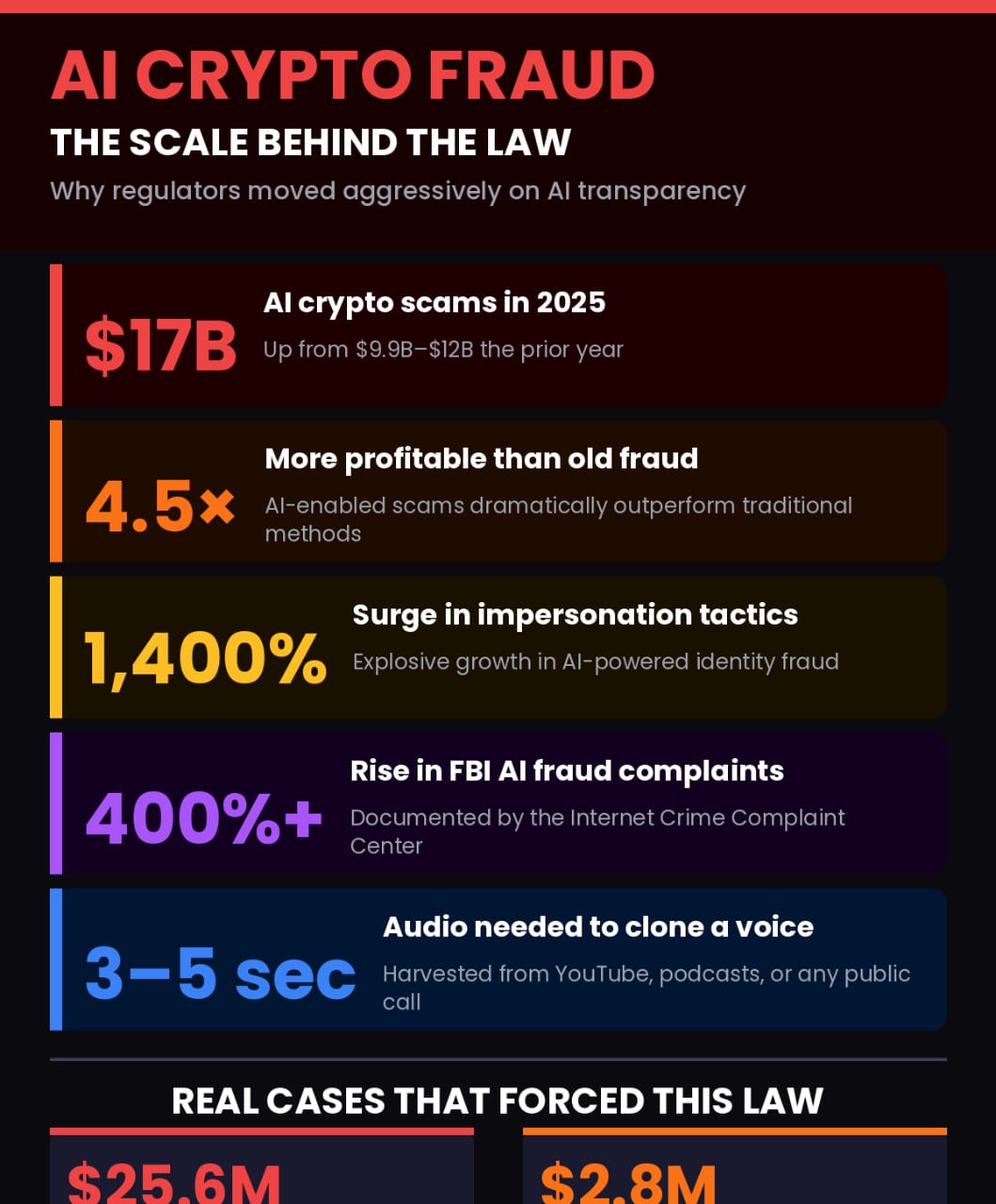
Lawmakers moved aggressively on transparency because AI-driven financial fraud has scaled rapidly. Chainalysis estimates that AI-powered crypto scams pulled in $14 billion to $17 billion on-chain in 2025 alone, climbing sharply from $9.9 billion to $12 billion the previous year. AI-enabled scams have proven roughly 4.5 times more profitable than traditional fraud, while impersonation tactics surged over 1,400%.
The technical barrier for this fraud has virtually vanished. Voice cloning now requires as little as three to five seconds of audio harvested from a single YouTube video, podcast, or public call. Victims of these evolving threats can report suspected attacks directly to the FBI’s Internet Crime Complaint Center (IC3), which has documented a 400%+ surge in AI-related fraud complaints.
Real Cases That Forced Regulatory Action
Two documented cases illustrate why lawmakers targeted deepfake disclosures specifically:
- The $25.6M Arup Video Call: Scammers impersonated multiple executives simultaneously on a live video conference, convincing an employee to authorize an urgent series of confidential transfers.
- The $2.8M Voice-Clone Attack: Fraudsters cloned an executive’s voice using publicly available video footage and convinced a team member to execute a multimillion-dollar transfer based on the phone call alone.
Mandatory, perceivable AI disclosures are designed to close the dangerous gap between suspicion and certainty during an interaction.
What This Means for Your Crypto Wallet
These transparency rules directly reshape your everyday security on web platforms and mobile apps in two main ways:
Stopping Fake Support Engineering
If you use an exchange or Web3 wallet operating in the EU, any chatbot agent must disclose its AI identity immediately. This closes off a common social engineering tactic where fake support reps build false trust before asking users to reveal seed phrases or approve malicious transactions.
Shutting Down Impersonator Scams
Crypto influencers, founders, and executives impersonated in fake promotional videos or fraudulent “AMA” streams must legally be labeled as artificial. While bad actors will continue attempting scams, mandatory labeling gives platforms, regulators, and security researchers a clear legal basis to take down undisclosed synthetic content much faster.
Reporting AI-Driven Fraud
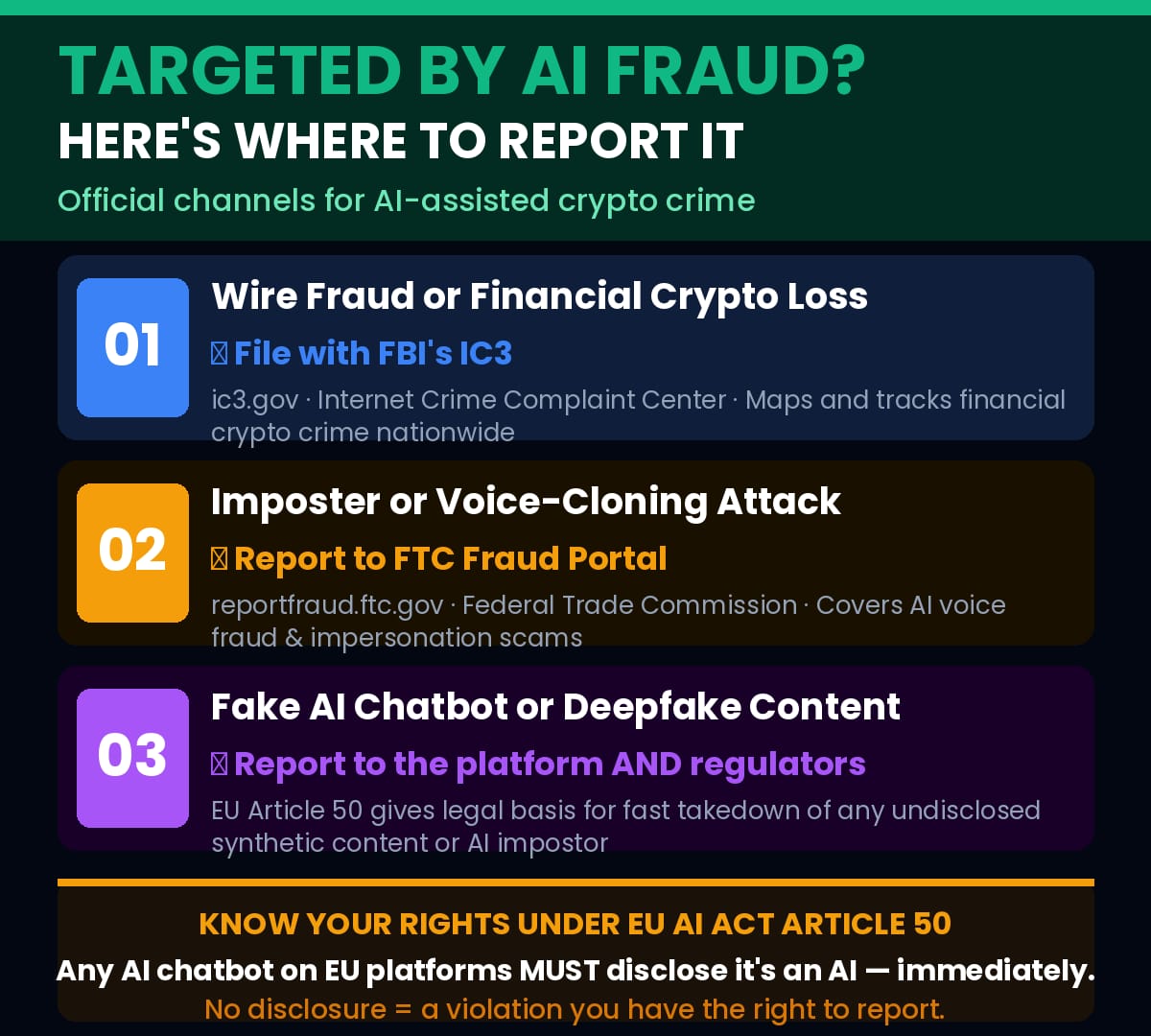
If you ever fall victim to an AI-assisted crypto scam, filing an official report helps regulators and platforms map emerging threats:
The Bottom Line
An AI system reaching EU users is no longer legally allowed to pretend it is a human being. In an industry that has lost billions to synthetic impersonation, these transparency mandates create a necessary layer of defense for everyday crypto users.
Disclosure: This is not trading or investment advice. Always do your research before buying any cryptocurrency or investing in any services.
Follow us on Twitter @themerklehash to stay updated with the latest Crypto, NFT, AI, Cybersecurity, and Metaverse news!