
Somewhere on a server, a chunk of today’s encrypted blockchain data is being saved. It’s a quiet act of digital piracy with a futuristic twist. The thief can’t read the data yet, but they’re betting that a machine that doesn’t exist today will pop it open like a cheap lock tomorrow.

This strategy, “Harvest now, decrypt later,” turns blockchain’s famous immutability from a feature into a liability.
The entire crypto world is built on a simple premise – Some math problems are just too hard for our fastest computers to solve. However, that premise is beginning to crack under the pressure of a new kind of computing. The race to build a quantum computer powerful enough to break it all has developers quietly wondering if their life’s work is built on a foundation of sand.
Skeleton key for digital vaults
Blockchain’s security hangs on a couple of clever math tricks. For networks like Bitcoin and Ethereum, the Elliptic Curve Digital Signature Algorithm (ECDSA) is what lets you prove you own your coins without revealing your master password – The private key. It works because it’s easy to do the math in one direction, but virtually impossible to reverse.
Quantum computers don’t play by the same rules. An algorithm cooked up by Peter Shor is a skeleton key designed specifically for this kind of lock. A full-scale quantum machine running Shor’s algorithm could look at a public key—which is often broadcast all over the blockchain—and work backwards to find the private key that controls it. From there, it’s game over. The attacker can sign any transaction they want.
Another quantum trick, Grover’s algorithm, gives a massive speed boost to brute-force guessing. While a less immediate threat, it puts a long-term target on the hashing that underpins crypto mining itself.
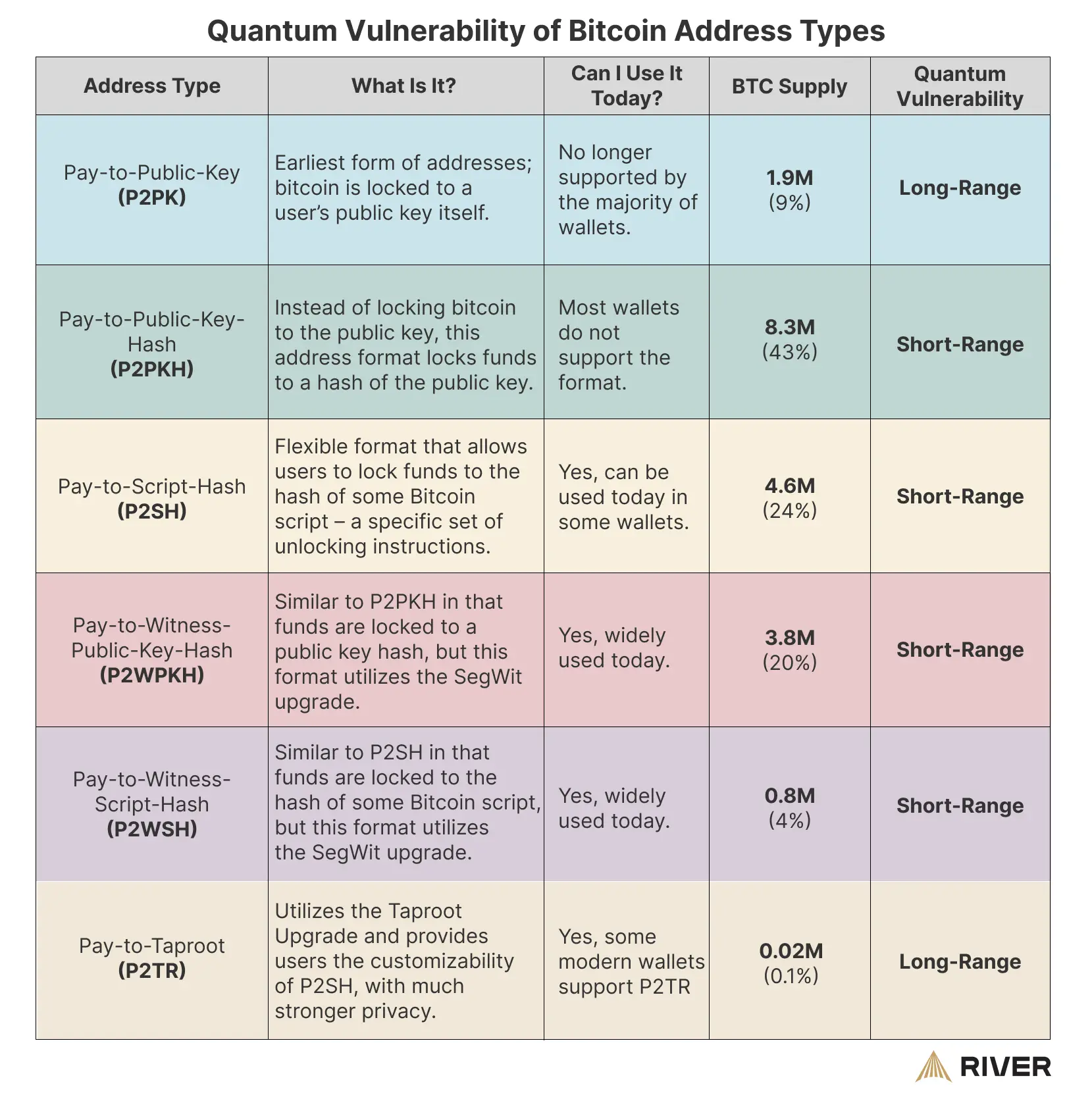
Source: River Financial
How soon is NOW?
Nobody is asking “if” anymore, only “when.” The clunky, error-prone quantum devices in labs today aren’t up to the task. However, the roadmaps from giants like IBM and Google show a sprint toward a machine that is, with milestones falling in the late 2020s and early 2030s.
In fact, a recent survey of global experts, the 2024 Quantum Threat Timeline Report, revealed a growing belief that the danger is closer than we think. Ethereum’s own Vitalik Buterin has given it chillingly specific odds, suggesting a one-in-five chance that modern encryption could be toast before 2030.
It’s this creeping reality that has governments scrambling. America’s National Institute of Standards and Technology (NIST) put its seal of approval on the first quantum-resistant encryption standards in August 2024, telling federal agencies to start planning their upgrades now.
A house of cards?
A quantum attack wouldn’t be a neat, surgical strike. It would be a systemic meltdown. The moment a major crypto asset is publicly compromised, the trust that holds the entire digital economy together would evaporate.
Think of the DeFi market. An attacker could forge signatures to drain every last dollar from lending protocols and liquidity pools, causing a cascade of forced liquidations that would send the whole system into a death spiral. NFTs wouldn’t be safe either; the digital signatures that guarantee your ownership of a Bored Ape could be forged, letting an attacker simply transfer it to their own wallet.
The very idea of digital scarcity would become a joke. Even our digital identities, increasingly tied to these same cryptographic proofs, could be hijacked.
Forging a quantum-proof shield
The industry isn’t just sitting around waiting for the inevitable. A whole new field of math called Post-Quantum Cryptography (PQC) is emerging as the defense. These are new algorithms designed from the ground up to resist attacks from both the computers we have today and the quantum machines of tomorrow.
After a years-long global competition, NIST has given us a new toolkit. For blockchains, three signature schemes stand out –
- CRYSTALS-Dilithium looks like the all-around workhorse, a solid replacement for what we use now.
- Falcon is the specialist, creating tiny signatures that are perfect for blockchains where every byte of data adds to network bloat.
- SPHINCS+ is the brute. Its signatures are huge and clunky, but its security is based on old-school hashing, which many cryptographers trust more than the newer, fancier math.
Open-heart surgery on a live network
Switching out a blockchain’s core cryptography is like trying to change a 747’s engines mid-flight. The new PQC algorithms create much bigger keys and signatures, which could clog networks, slow down transactions, and drive up fees.
Getting a global, decentralized community to agree on an upgrade is a political nightmare.
A hard fork offers a clean break, forcing everyone onto the new system at once. However, it could easily split a community and the currency in two. A soft fork is gentler, allowing users to opt-in, but it’s a messier and slower transition that would leave laggards exposed.
The most likely solution is to build for crypto-agility, creating systems where the cryptographic engine can be hot-swapped as needed. Maybe even running old and new signatures side-by-side for a while.
Who’s getting ready?
You can already see a divide forming between projects that are taking this seriously and those with their heads in the sand.
- The Quantum Resistant Ledger (QRL) was, as the name suggests, paranoid from the start. It was built with quantum resistance baked in and is already upgrading to one of the new NIST-approved standards. This foresight has even caught the eye of defense contractors like Lockheed Martin.
- Ethereum is betting on its own flexibility. Thanks to a concept called Account Abstraction, individual users can essentially upgrade their own wallets to use new signature schemes without waiting for a massive, network-wide vote. Vitalik Buterin seems confident, noting that some of Ethereum’s future tech, like STARKs, is already naturally resistant to quantum attacks.

Source: Medium
Is this all just hype?
Of course, not everyone is buying the doomsday-is-nigh narrative. Adam Back, one of the old-guard cypherpunks mentioned in the Bitcoin whitepaper, thinks we have another twenty years before this becomes a real problem, treating it as a routine upgrade to be handled down the road.
The skeptics have a point. Building a quantum computer that can actually run Shor’s algorithm is a monumental task. Today’s machines are incredibly “noisy” and unstable.
It might take thousands, or even millions, of these fragile physical “qubits” just to create the handful of stable “logical qubits” needed to break a single key. The sheer cost and energy to pull that off might make it an economically absurd venture.
Upgrade is coming, ready or not!
Whether the timeline is five years or twenty, the destination is the same. The move to post-quantum cryptography is no longer a theoretical exercise. Instead, it’s a necessary evolution. With governments now setting deadlines and the “harvest now” threat looming, sitting still is the riskiest move of all.
The coming years will be a test of the entire decentralized promise. The platforms that treat this not as a distant problem but as an active engineering challenge are the ones that will still be standing when the quantum dawn breaks.